
THE TECHNOLOGY
What Is Force Deck Testing?
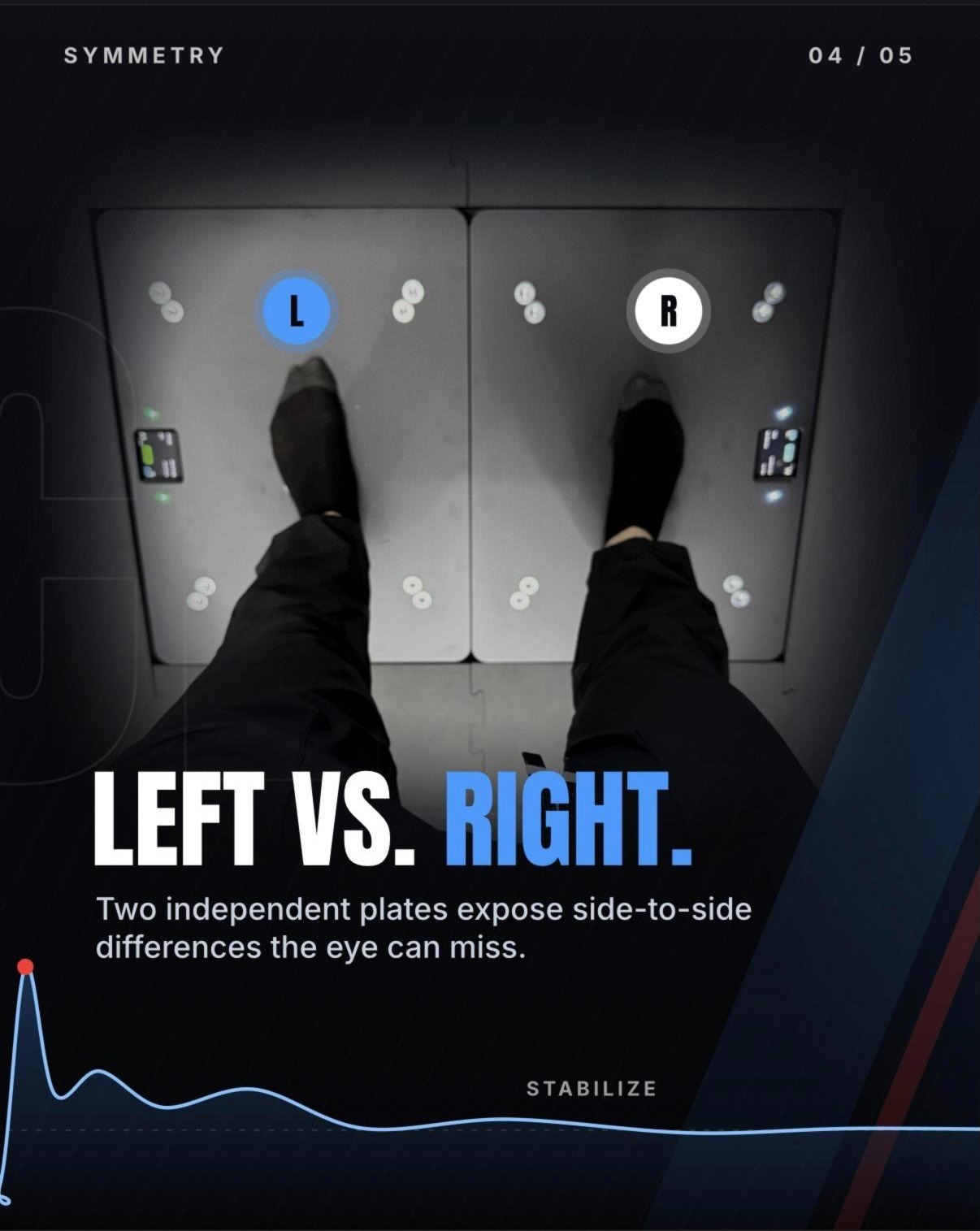
Force decks are dual force plates that measure the force each leg produces against the ground, sampled hundreds of times per second. As you jump, land, or hold a position, the sensors capture how much force you create, how quickly you create it, and how evenly it is shared between your left and right sides, turning movement into objective, repeatable data.
Why We Test Instead of Guess
Stop guessing. Start measuring.
Pain Goes Away Before Strength Comes Back
Most athletes feel ready weeks or months before their injured leg has caught up.
Your Body Is Great at Compensating
You can jump nearly as high as before an injury by leaning on your good leg, and never know it.
Objective, Repeatable Numbers
Hand-held strength checks are hard to repeat. Force decks give us a number we can track together.
OUR TEST BATTERY
The Tests We Use
01
Countermovement Jump
A quick dip and jump with both feet. Our go-to test for power, loading, and landing.
02
Single-Leg Jump
The same jump, one leg at a time. This is where side-to-side differences really show up.
03
Drop Jump
Step off a small box and bounce right back up to measure how you absorb force and spring out of it.
04
Isometric Strength
Push or pull as hard as you can against something that doesn't move. Safe to use early in rehab.
05
Balance & Landing
We track how much you sway and how quickly you settle on one leg.
Reading Your Results
Output
Jump height, peak force, and power. How much you can produce.
Strategy
Rate of force development, braking and propulsive force, Reactive Strength Index, and time to stabilize. How you got there.
Symmetry
The percentage difference between your legs. Differences over about 10-15% are commonly flagged, and many return-to-sport guidelines look for the injured leg to reach at least 90% of the other side. We treat 90% as a minimum, not a finish line.
WHO IT'S FOR
Who Should Get Tested?
› Athletes coming back from ACL, knee, ankle, Achilles, or hip injuries
› Runners with injuries that keep coming back
› Baseball, volleyball, and other overhead athletes
› Healthy athletes who want a preseason baseline
› Anyone chasing a higher vertical or a faster first step

Force Deck Testing
What to Expect
A short conversation about your history and goals, a standardized warm-up, your test battery, and a walk-through of your results. You'll leave knowing exactly where you stand and what we're working on next. During rehab or a training block, we usually retest every few weeks so you can see the progress for yourself.